Why Is Whey Protein So Expensive in Australia in 2026?
Author: Professional Whey Date Posted:7 August 2026


The forces pushing up whey protein prices and what Australian consumers can expect going forwards
August 2026
If you have bought whey protein recently, you have probably noticed that prices are much higher than they were only a few years ago. This is not limited to one Australian brand. The wholesale cost of concentrated whey ingredients has risen rapidly worldwide, with further increases continuing through 2026.
Like many Australian protein companies, Professional Whey has had to manage repeated supplier price increases while doing everything reasonably possible to keep products affordable.
Why has whey protein become so expensive?
There is no single cause. The current price is the result of rapidly growing demand meeting a supply chain that cannot expand quickly enough. Based on what our suppliers are telling us, the largest pressure at present is unprecedented demand from the United States.
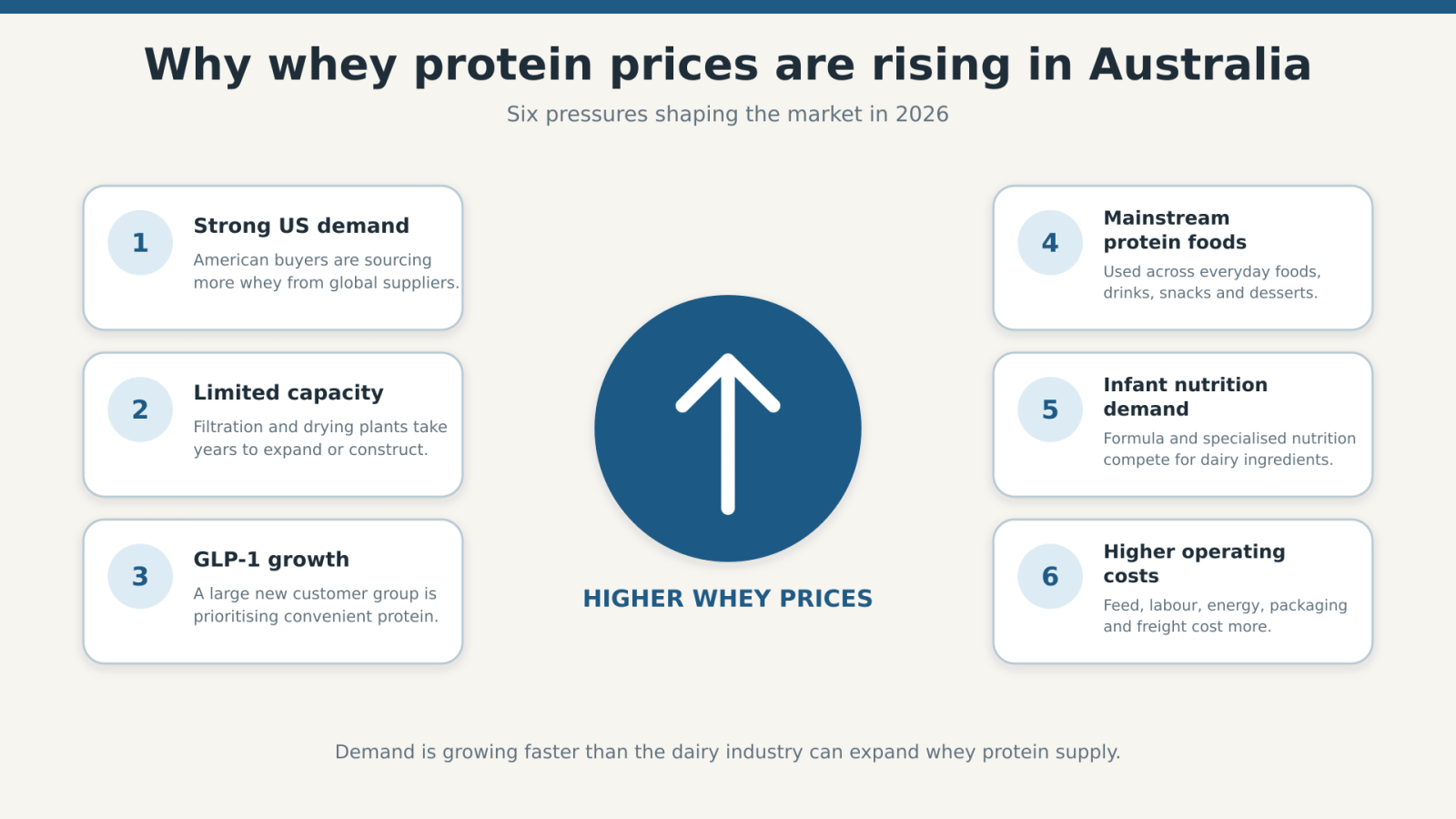
1. The United States is drawing on global whey supplies
The US market for whey protein concentrate (WPC) and whey protein isolate (WPI) is extremely tight. Demand from food and supplement manufacturers is exceeding available supply, causing American buyers to seek more whey from countries including Australia.
This affects Australian consumers because whey is traded in a global market. Australian whey does not automatically remain here. When overseas buyers compete for limited stock and are prepared to pay more, the international price rises and local companies must compete at that new price.
That is why a product made in Australia can become more expensive even when the milk and processing are local. Its value is influenced by global demand, export opportunities, processing capacity and the Australian dollar, not only by domestic milk prices.
2. Whey supply cannot increase quickly
Most commercial sweet whey used to produce mainstream WPC and WPI begins as the liquid whey created during cheese production. It must then be filtered, concentrated and dried using specialised dairy processing equipment.
Producing more whey protein therefore requires more than simply obtaining extra milk. The industry needs suitable liquid whey and sufficient filtration and drying capacity. New processing facilities require major investment and can take years to plan, approve and build.
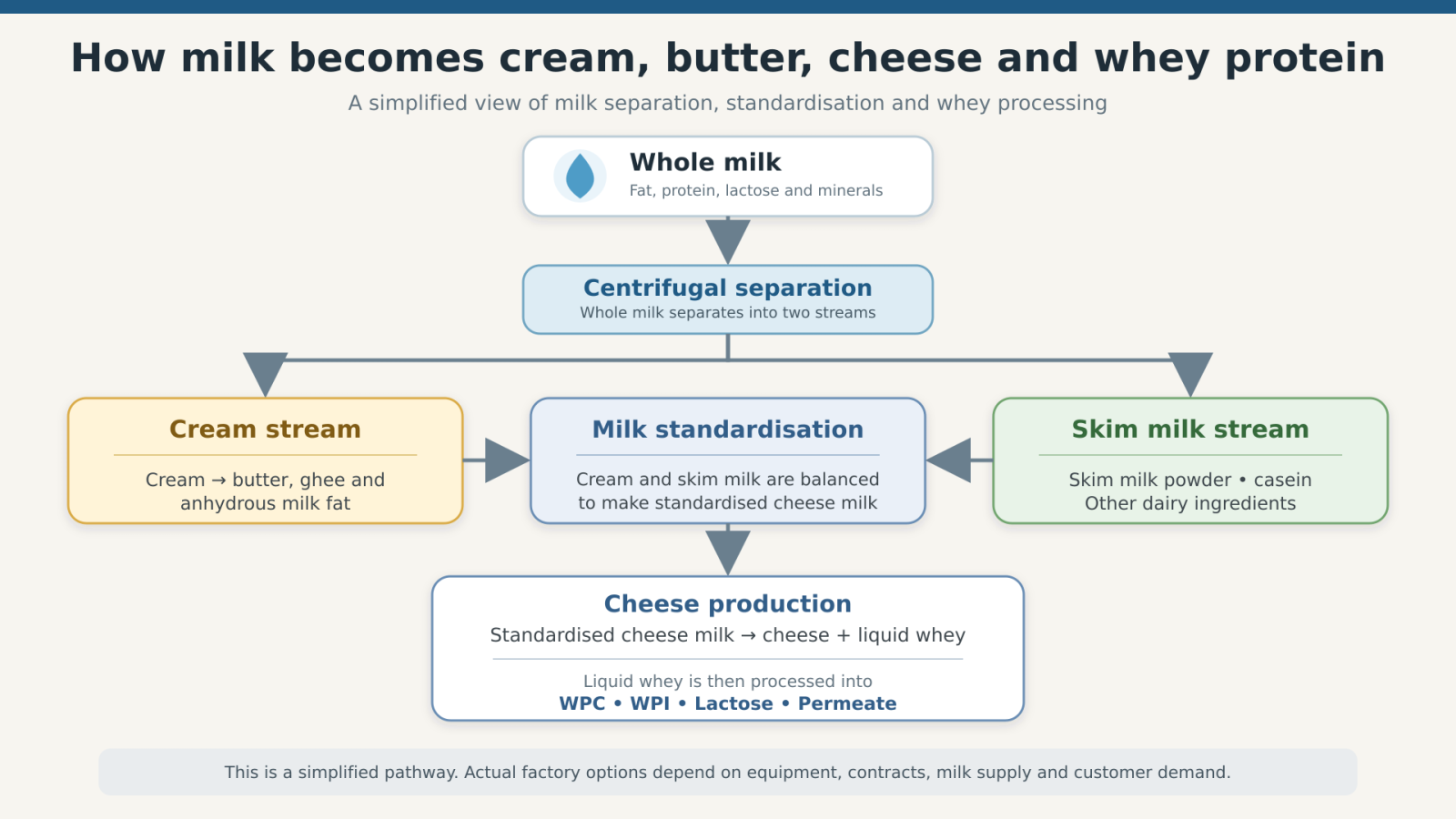
One of our suppliers recently explained that the exceptional value of whey protein has changed the economics of cheese production. Normally, when cheese prices fall, dairy processors may reduce cheese production and direct more of their available milk towards products offering better returns, such as butter, cream or milk powders.
However, whey protein prices are now so high that processors can continue producing cheese even when cheese itself is providing a relatively low return. The valuable whey stream supports the overall profitability of production, which is helping to keep cheese supply consistently high. As one of our suppliers put it,
"Economically, cheese has almost become a byproduct of whey protein production."
3. GLP-1 medications are creating a new protein market
Another important influence is the rapid adoption of GLP-1 based treatments, including Ozempic®, Wegovy®, Mounjaro® and similar treatments.
These medications can substantially reduce appetite and total food intake. During weight loss, some of the weight lost may be lean tissue rather than body fat. Current expert guidance therefore commonly prioritises adequate protein and resistance exercise to help preserve muscle and physical function during GLP-1 assisted weight loss as outlined in a 2025 joint clinical advisory on nutritional priorities during GLP-1 therapy.
With millions of people using these medications, even a moderate increase in protein consumption per person creates significant additional demand. Whey is a complete, high quality protein that is convenient, easy to measure and simple to add to a diet with fewer calories.
GLP-1 use is not the only cause of higher whey prices, but it has added a large new customer group to an expanding market. Many users are also willing and able to pay for convenient protein products alongside costly GLP-1 treatment, particularly when protein is helping them lose fat while preserving muscle.
4. Whey protein is no longer just for gym users
Twenty years ago, whey protein was purchased mainly by bodybuilders, gym enthusiasts and athletes. In 2026, it is a mainstream food ingredient.
Supermarkets now stock high protein yoghurts, flavoured milks, cereals, breads, snack bars, ready to drink shakes, protein waters, baked goods and desserts with added protein. Whey is valued for its protein quality and useful manufacturing properties such as solubility, texture and emulsification.
The customer base has expanded too. Protein products are used by busy adults seeking a convenient meal or snack, older people wanting to maintain muscle, people recovering from illness, weight management consumers and those who struggle to meet their protein needs through meals alone.
5. Infant formula and specialised nutrition compete for supply
Whey ingredients are widely used in infant formula because of their nutritional and functional properties. Strong infant nutrition demand, particularly across Asia, therefore competes for parts of the same dairy ingredient supply chain.
Rising incomes in countries such as China have also increased demand for premium dairy foods and specialised nutrition. Sports supplements, clinical nutrition, infant formula and everyday foods are all seeking high quality dairy proteins.
6. Dairy farming, processing and freight all cost more
Producing a finished bag of whey protein has also become more expensive. Dairy farmers and manufacturers face higher costs for feed, labour, electricity, fuel, transport, filtration, drying, quality testing, food safety, packaging and storage.
International freight and logistics costs remain above historical levels, while currency movements can add further pressure when ingredients, equipment or packaging inputs are priced internationally. Each cost adds another layer to the much larger increase in the underlying whey ingredient.
How much have Professional Whey’s supplier prices increased?
Based on our own experience, Professional Whey received three wholesale price increases during 2025 and another two three during 2026. The most recent increase was approximately 30%.
We have absorbed as much of these increases as we realistically can. However, when the cost of our main ingredient rises repeatedly, sometimes by this magnitude, it eventually becomes impossible to maintain the previous retail price without compromising product quality or business viability.
Our goal is to keep offering high quality Australian and NZ whey at a sustainable price. We will continue reviewing our costs carefully and pass on increases only when necessary.
Will whey protein prices fall again?
Nobody can predict commodity pricing with certainty. Lower demand, greater production capacity, a stronger Australian dollar or reduced manufacturing costs could eventually provide some relief.
However, based on current global conditions and what we are hearing directly from suppliers, we do not expect whey protein prices to return to their former levels soon. Much of the growth from mainstream foods with added protein, healthy ageing nutrition and GLP-1 use appears structural rather than temporary. New processing capacity is being developed internationally, but it cannot come online overnight.
Unless the balance between global supply and demand changes substantially, prices are likely to remain elevated and further wholesale increases remain possible.
What are the more affordable alternatives to whey protein?
For customers mainly seeking an economical way to increase their daily protein intake, whey is not the only option. Depending on dietary needs, taste and intended use, alternatives include:
Each protein has different nutritional, flavour and mixing characteristics, but all can contribute to total dietary protein intake. Compare the amount of protein provided per serve, not only the bag size or headline price, to assess value accurately.
Learn more about the global whey shortage
ABC Landline examined the shortage in its report, USA looks to Australia to solve whey protein shortage, released on 24 July 2026. It explains how strong US demand is drawing whey from Australia and contributing to higher prices worldwide and provides a good overview of some of the current market conditions.
_____________________________________________________
Frequently Asked Questions
Why is Australian whey protein affected by US demand?
Whey is sold into an international market. When US manufacturers buy more Australian whey, local buyers must compete with export demand for limited supply, which pushes up Australian wholesale prices.
Are GLP-1 medications the main cause of the whey shortage?
They are an important new source of demand, but not the only cause. Mainstream foods with added protein, sports nutrition, healthy ageing products, infant formula and limited processing capacity are also contributing.
Is whey protein still good value?
For many people, whey remains a convenient source of complete, high quality protein. Value should be assessed by protein per serve, ingredient quality and suitability, not price per kilogram alone.
Will whey protein get cheaper in 2027?
It is too early to know. Additional processing capacity may eventually help, but current demand is strong and new facilities take time to build. Further price increases remain possible in the short term.